Everything you need to know before planning a trip to Spiti Valley — itinerary, budget, permits, hotels, and the best time to visit.
Spiti Valley is one of India's most breathtaking high-altitude destinations — a remote trans-Himalayan desert wedged between Tibet and the greater Himalayas at an average elevation of 3,800 m (12,467 ft). Famous for its ancient Buddhist monasteries perched on cliff faces, ochre and slate-grey mountain landscapes, and some of the most thrilling mountain roads on earth, Spiti is a true paradise for adventure travellers, photographers, and seekers of solitude.
Unlike the more tourist-heavy Leh-Ladakh circuit, Spiti retains a raw, unhurried character. Villages like Langza, Hikkim, and Komic sit above 4,500 m and have barely changed in centuries. This guide covers everything you need — when to go, how to get there, what to see, where to stay, how much to budget, and the permits you'll need.
Best Time to Visit Spiti Valley
Spiti Valley is accessible for roughly six months of the year. The window depends on which route you take and whether the high mountain passes are open.
| Season | Months | Conditions | Best For |
|---|---|---|---|
| Summer | May – June | Passes just opening, snow patches, cool nights | First-timers, road trippers |
| Monsoon | July – Aug | Rain in lower Himachal but Spiti stays dry | Budget travel, fewer crowds |
| Autumn | Sep – Oct | Clear skies, golden light, moderate temperatures | Photography, trekking |
| Winter | Nov – Apr | Both passes closed, only Pin Valley accessible | Hardcore winter expeditions |
How to Reach Spiti Valley
There are two main road routes into Spiti Valley. Neither is easy, and that's part of the appeal.
Route 1 — Via Shimla (Hindustan–Tibet Highway)
The Shimla–Narkanda–Rampur–Reckong Peo–Nako–Tabo–Kaza route is 412 km and takes 12–14 hours. This route is open year-round (except during heavy snowfall) and is the gentler introduction to altitude, allowing for gradual acclimatisation. It passes through the stunning Kinnaur district before entering Spiti.
Route 2 — Via Manali (Rohtang & Kunzum Pass)
The Manali–Rohtang Pass–Gramphu–Batal–Kunzum Pass–Kaza route is 200 km but takes 9–11 hours due to road conditions. Kunzum Pass (4,590 m) is only open from late May to October. This route offers more dramatic, high-altitude scenery and is popular with bikers.
Nearest Airport & Rail
The nearest airport is Bhuntar (Kullu Manali Airport), 245 km from Kaza. The nearest railway station is Shimla (narrow gauge) or Chandigarh for mainline trains. From either point, the journey into Spiti is entirely by road.
Permits Required for Spiti Valley
Spiti Valley is an Inner Line Permit (ILP) area for foreign nationals. Indian citizens do not need any special permit to visit Spiti, but there are a few checkpoints where you must register.
- Foreign nationals require an Inner Line Permit (ILP) — available at the Sub-Divisional Magistrate (SDM) office in Reckong Peo or Kaza
- ILP costs ₹500 per person and is valid for 7 days (extendable)
- All visitors must register at the checkpost at Sumdo (Shimla route) or Gramphu (Manali route)
- Carry government-issued photo ID (Aadhaar, passport) for all checkposts
- Certain villages near the Tibetan border (e.g., Kibber, Tashigang) may require additional permissions
Places You Shouldn't Miss
Spiti is compact but extraordinarily dense with remarkable sights. Here are the must-visits.
Kaza — The District Headquarters
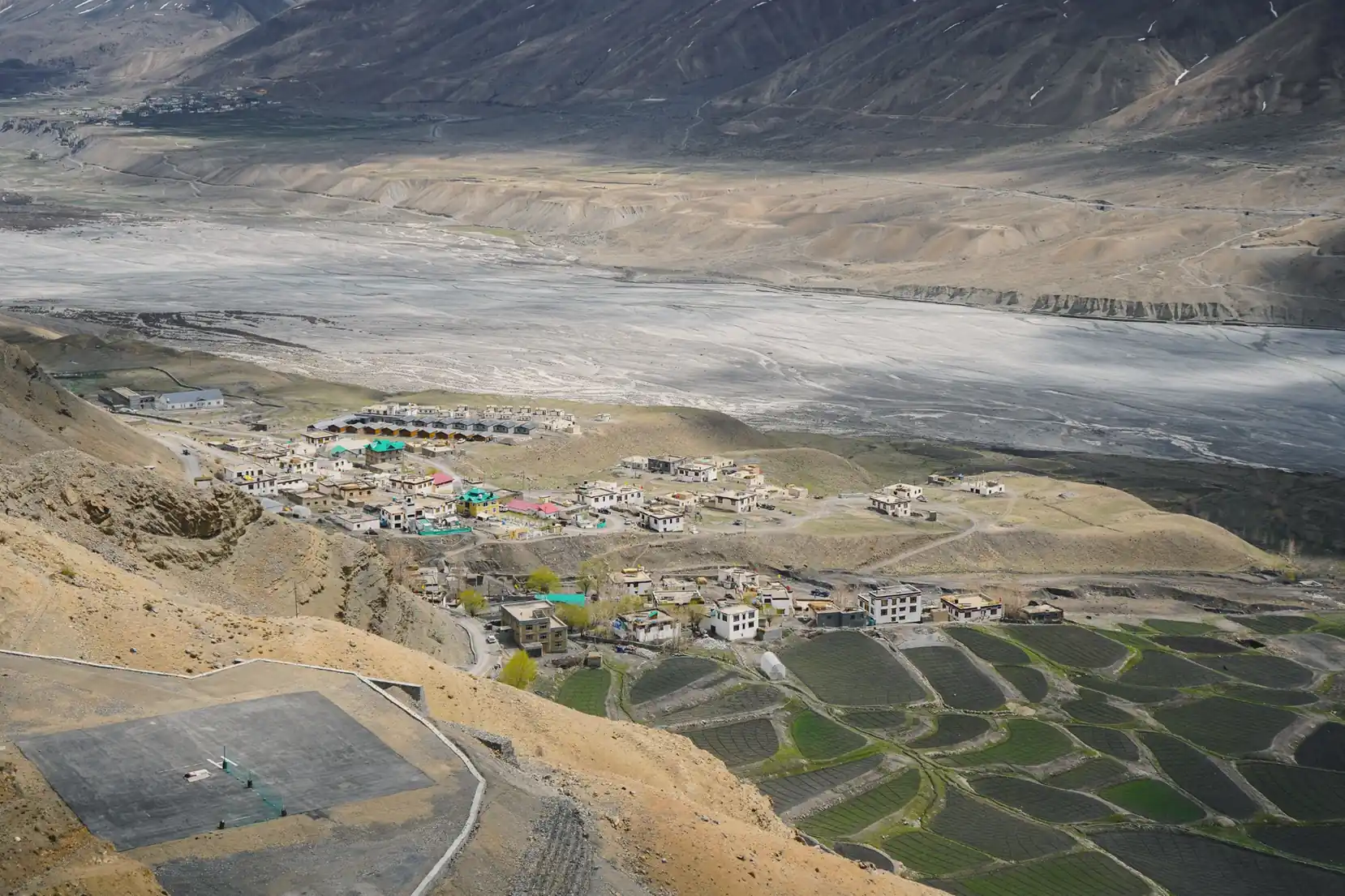
Kaza (3,800 m) is the largest town in Spiti and your natural base. It has ATMs, mobile connectivity (BSNL works most reliably), pharmacies, and a growing selection of guesthouses and cafes. The town itself is modest but charming, and the surrounding views of the Spiti River gorge are spectacular.
Key Monastery (Ki Gompa)
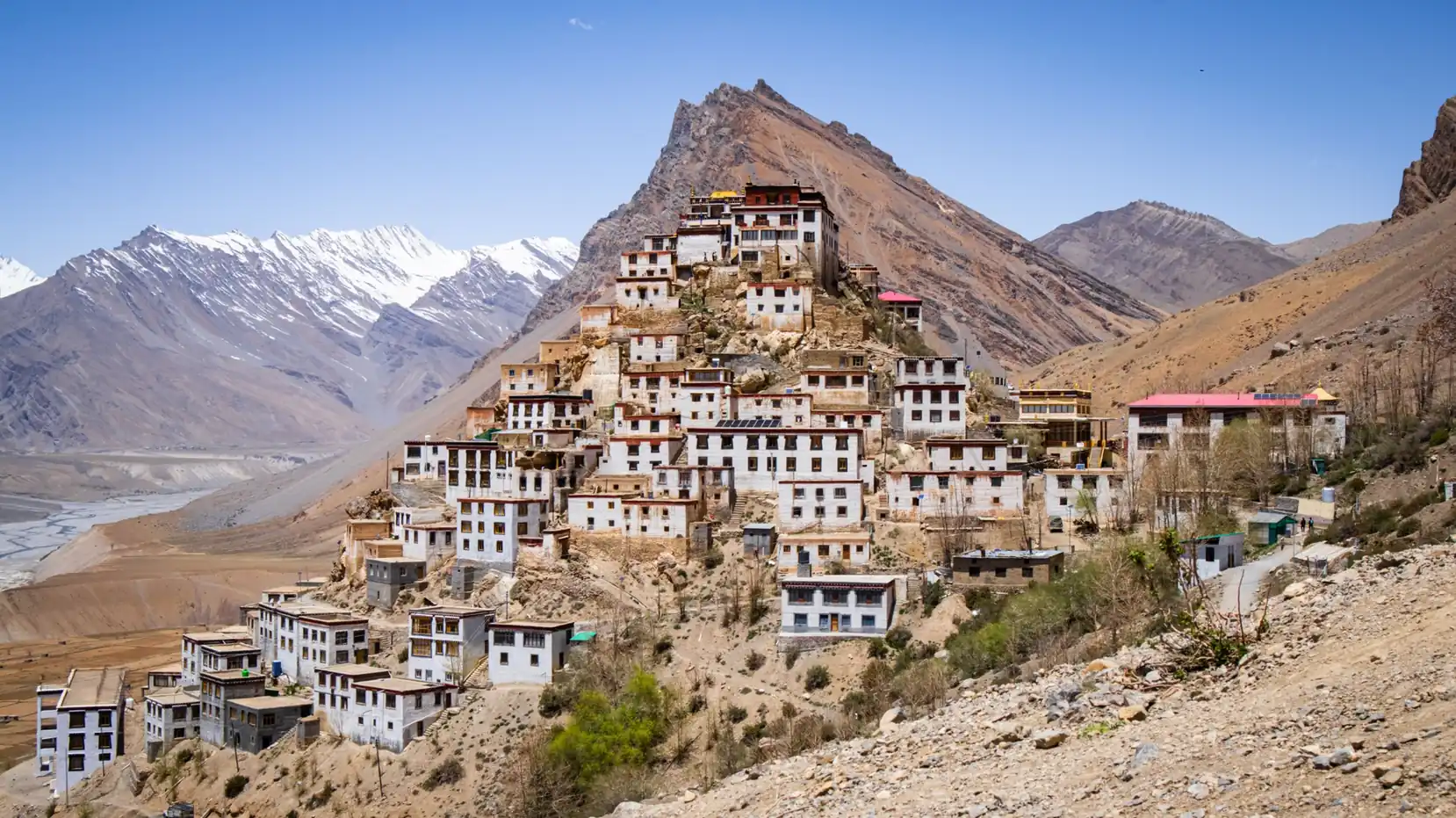
Perched dramatically on a hilltop 14 km from Kaza at 4,166 m, Ki Monastery is the largest in Spiti and dates back to the 11th century. Home to around 300 monks of the Gelug sect, it houses remarkable thangka paintings, sacred scriptures, and ancient weapons. The views from the monastery over the Spiti River valley are among the best in the region.
Chandratal Lake
The 'Moon Lake' (4,300 m) near Batal is one of Spiti's most iconic sights — a crescent-shaped glacial lake of impossibly blue water ringed by scree slopes and snowfields. The 6 km trek from the parking area at Chandra is straightforward but at altitude. Camping at Chandratal is permitted but numbers are now limited to protect the fragile ecosystem.
Langza — The Fossil Village
At 4,400 m, Langza is famous for marine fossils found in its surrounding fields — evidence that this entire region was once a seabed. A large golden Buddha statue watches over the village. The drive from Kaza is 14 km on a rough track, and the views back down the valley are breathtaking.
Hikkim — World's Highest Post Office
Just 6 km from Langza, Hikkim holds the distinction of having the world's highest operational post office at 4,440 m. You can send a postcard from here — it's one of those rare, genuinely meaningful travel moments.
Komic — World's Highest Motorable Village
Komic (4,587 m) is reputedly the world's highest village accessible by a motorable road. It's a tiny cluster of white-washed homes around the ancient Tangyud Monastery. The silence and the scale of the landscape here are hard to describe.
Tabo Monastery
Founded in 996 CE, Tabo is often called the 'Ajanta of the Himalayas' for its extraordinarily well-preserved murals and stucco sculptures. It is one of the oldest continuously functioning Buddhist monasteries in the world. The Dalai Lama has expressed a wish to retire here — that alone tells you something.
Dhankar Monastery & Lake
Perched vertiginously on a cliff above the confluence of the Spiti and Pin rivers, Dhankar Gompa (3,894 m) is one of the most dramatically situated monasteries in the world. A 45-minute hike above the monastery leads to the emerald Dhankar Lake — one of the valley's hidden gems.
Suggested Itineraries
7-Day Itinerary (Shimla to Kaza)
- Day 1 — Delhi to Shimla (overnight train or bus, 370 km)
- Day 2 — Shimla to Nako via Reckong Peo (210 km, 7–8 hrs). Overnight at Nako (3,662 m).
- Day 3 — Nako to Tabo (70 km, 2–3 hrs). Explore Tabo Monastery. Overnight at Tabo.
- Day 4 — Tabo to Kaza via Dhankar (90 km, 4 hrs with stops). Check into Kaza.
- Day 5 — Kaza base day. Visit Langza, Hikkim, Komic. Return to Kaza.
- Day 6 — Kaza to Key Monastery and Kibber. Half-day excursion to Chicham Bridge. Back to Kaza.
- Day 7 — Kaza to Chandratal Lake and exit towards Manali via Kunzum Pass.
10-Day Complete Circuit (Manali ↔ Shimla)
- Day 1 — Manali to Batal via Rohtang (80 km). Acclimatize at Batal (3,960 m).
- Day 2 — Batal to Kaza via Kunzum Pass (75 km). Settle into Kaza.
- Day 3 — Kaza rest day + local market. BSNL SIM recommended.
- Day 4 — Kaza village circuit: Langza, Hikkim, Komic.
- Day 5 — Key Monastery, Kibber, Chicham Bridge.
- Day 6 — Day trip to Pin Valley (Mudh village, Pin River, Ibex sightings).
- Day 7 — Kaza to Chandratal Lake camping (80 km). Stay overnight at campsite.
- Day 8 — Chandratal to Tabo via Kaza (115 km). Explore Tabo.
- Day 9 — Tabo to Reckong Peo via Dhankar and Nako.
- Day 10 — Reckong Peo to Shimla (200 km, 7–8 hrs). Journey ends.
Where to Stay in Spiti Valley
Accommodation in Spiti ranges from basic homestays to comfortable guesthouses. There are no luxury hotels in the valley — and honestly, that's a feature, not a bug.
| Location | Type | Price Range (per night) | Notes |
|---|---|---|---|
| Kaza | Guesthouse / Hotel | ₹800 – ₹3,000 | Most options; best connectivity |
| Tabo | Monastery guesthouse | ₹500 – ₹1,500 | Peaceful, basic, authentic |
| Nako | Homestay | ₹600 – ₹1,200 | Simple, village-style |
| Chandratal | Tent camps | ₹1,500 – ₹3,500 | Limited bookings; book ahead |
| Langza / Hikkim | Homestay | ₹500 – ₹1,000 | Minimal facilities, unforgettable |
| Pin Valley (Mudh) | Homestay | ₹400 – ₹800 | Very basic, remote, magical |
Budget Breakdown
Spiti is relatively affordable if you travel simply. Here's a realistic daily budget estimate for a 7–10 day trip.
| Category | Budget (₹/day) | Mid-range (₹/day) |
|---|---|---|
| Accommodation | ₹500 – ₹900 | ₹1,200 – ₹2,500 |
| Food (3 meals) | ₹300 – ₹500 | ₹600 – ₹1,000 |
| Transport (shared taxi / bike fuel) | ₹200 – ₹500 | ₹800 – ₹2,000 |
| Entry fees & permits | ₹50 – ₹150 | ₹50 – ₹150 |
| Miscellaneous | ₹100 – ₹200 | ₹200 – ₹500 |
| Total per day | ₹1,150 – ₹2,250 | ₹2,850 – ₹6,150 |
A 10-day trip from Delhi (including overnight buses/trains both ways) can be done for ₹18,000 – ₹25,000 on a budget, or ₹40,000 – ₹60,000 mid-range. Bike rentals from Manali add ₹6,000 – ₹12,000 for the trip.
Altitude Sickness — What You Must Know
Acute Mountain Sickness (AMS) is the single biggest risk in Spiti. The valley sits between 3,600 m and 4,600 m — elevations at which the body genuinely struggles if you ascend too quickly.
Symptoms to watch for
- Persistent headache that worsens at night
- Nausea or vomiting
- Dizziness or loss of balance
- Fatigue disproportionate to exertion
- Loss of appetite
- Shortness of breath at rest
Prevention
- Ascend slowly — spend at least 1 night at 2,000–2,500 m (Shimla / Reckong Peo) before going higher
- Drink 3–4 litres of water daily — hydration is critical
- Avoid alcohol for the first 48 hours at altitude
- Avoid sleeping pills and sedatives
- Carry Diamox (Acetazolamide 250 mg) — consult your doctor before the trip
- If symptoms worsen, descend immediately — do not wait
What to Pack for Spiti
- Thermal base layers (even in summer, nights drop to 2–5°C)
- Windproof and waterproof outer jacket
- Sturdy trekking boots (ankle support matters on loose scree)
- Sunscreen SPF 50+ — UV is extreme at altitude
- Polarised sunglasses — snow blindness is a real risk
- Lip balm and moisturiser (air is extremely dry)
- Personal first aid kit with AMS medication
- Power bank — electricity supply can be unreliable
- Cash in small denominations — ATMs in Kaza sometimes run dry
- Offline maps (Maps.me or Google Maps downloaded offline)
- Reusable water bottle with filter
- Lightweight trekking poles (helpful at altitude)
Connectivity & Practical Tips
- BSNL is the only reliable network in Spiti — get a BSNL SIM before entering (Shimla or Manali)
- ATMs exist in Kaza but carry sufficient cash — they often run out during peak season
- Petrol / diesel is available in Kaza; carry a spare 5L jerry can for remote routes
- Electricity supply is 4–6 hours per day in most villages; charge devices whenever possible
- Respect Buddhist customs — walk clockwise around monasteries and stupas
- Do not litter — Spiti's ecosystem is fragile and waste takes decades to decompose at this altitude
- Plastic bags are banned in Spiti district — bring cloth bags
"Spiti is not a destination you visit — it is a place that happens to you. The mountains here are not backdrop; they are the main event."
— Lama Travels field journal
Is Spiti Right for You?
Spiti Valley is not for everyone — and that is what makes it special. Roads are rough, altitude is serious, infrastructure is basic, and connectivity is limited. But for those who come prepared, it delivers an experience that most Himalayan destinations simply cannot: genuine remoteness, ancient culture still alive and unperformed, and landscapes of such scale that your sense of proportion is permanently recalibrated.
If you're planning your first visit, choose a 7–9 day itinerary to properly acclimatise and explore the valley at a pace that lets you actually feel it rather than just photograph it. Let Lama Travels help you plan a journey that is safe, thoughtful, and deeply memorable.